You Can't Be In a Rom-Com with Your Childhood Friends! is a sweet, awkward time capsule that can't decide what decade it's in
There's a particular kind of anime that feels like it was discovered in a time capsule buried in 2007, dusted off, and presented to us with a shrug and a "well, it's still technically functional." You Can't Be In a Rom-Com with Your Childhood Friends! (let's mercifully shorten that to Childhood Friends Rom-Com for everyone's sanity) is precisely that kind of artifact—a show that premiered on USTREAM in 2012 (yes, that USTREAM, the one that feels as dated as MySpace) and now arrives in our streaming-saturated present like a visitor from another dimension. Directed by Yasuhiro Takemoto, whose most famous work remains the beautifully atmospheric Hyouka, this series represents a fascinating case study in how certain anime tropes have fossilized while others have evolved. It's not just a show about awkward teenage feelings; it's awkward about its own existence in the contemporary anime landscape.
The 2000s harem comedy skeleton in a 2020s streaming closet
Childhood Friends Rom-Com wears its influences on its sleeve with the subtlety of a neon sign in a library. The setup—a hapless male protagonist caught between two childhood friends who have suddenly become attractive—feels plucked directly from the mid-2000s harem comedy playbook, complete with the protagonist's internal monologue about how he's "the only one looking sexually at them now that they've grown up." This premise would have felt comfortably familiar in 2007, nestled between Love Hina reruns and the early seasons of The Familiar of Zero. But in 2024, after we've seen shows like Kaguya-sama: Love Is War dissect romantic tropes with surgical precision and Rent-a-Girlfriend exhaust every possible permutation of romantic anxiety, this setup feels less like a premise and more like a museum exhibit. The show's 6.1/10 score on major platforms (contrasted with its more forgiving 7.35/10 on MyAnimeList) suggests a generational divide in how audiences receive this material. For older viewers, it might feel nostalgic; for younger ones, it might feel like watching their parents' idea of romance.
Takemoto's direction: When atmospheric mastery meets generic material
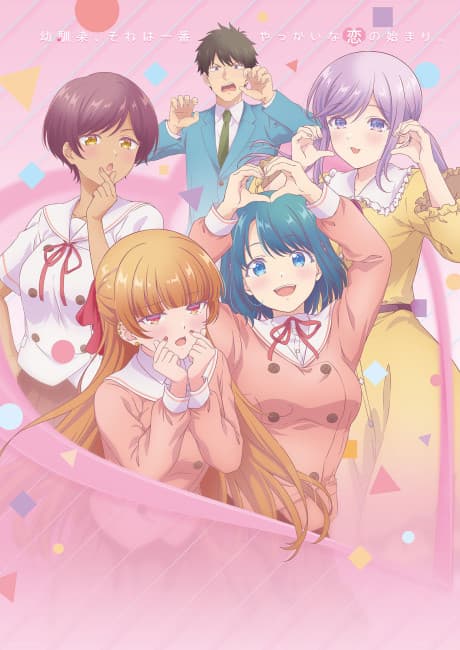
Yasuhiro Takemoto's involvement here is the most fascinating aspect of Childhood Friends Rom-Com. This is the director who gave us Hyouka, a series celebrated for its meticulous attention to atmosphere, its willingness to let silence speak volumes, and its almost painterly approach to mundane moments. In Childhood Friends Rom-Com, you can see flashes of that same sensibility—moments where the camera lingers on a character's expression just a beat longer than necessary, or where the sound design (overseen by Youta Tsuruoka) emphasizes ambient noise over dialogue. But these touches feel like a master chef trying to elevate instant ramen. The material simply doesn't support the level of craft Takemoto brings to it. The characters—Eeyuu, Shio, and Akari—are archetypes rather than people: the anxious protagonist, the cheerful childhood friend, the more reserved childhood friend. They lack the specificity and interiority of Hyouka's Oreki Houtarou or Chitanda Eru, who felt like real teenagers with particular ways of moving through the world. Here, the direction occasionally transcends the script, but more often, it highlights how generic the foundation really is.
The childhood friend trope: From narrative convenience to cultural baggage
Let's talk about the childhood friend trope itself, because Childhood Friends Rom-Com treats it with the reverence of a sacred text rather than the critical eye it deserves. In anime, the childhood friend has evolved from a simple narrative device (someone who knows the protagonist's backstory without needing exposition) to a complex symbol of nostalgia, safety, and often, narrative inevitability. The show's subtitle—"A sweet and impatient love triangle love comedy where you can't be honest!"—could serve as the dictionary definition of the childhood friend romance genre. But what's missing here is any interrogation of why these characters can't be honest, beyond the surface-level awkwardness of changing relationships. Compare this to how a show like Toradora! used the childhood friend dynamic to explore how familiarity can both comfort and constrain, or how Oregairu deconstructed the very idea of "honesty" in teenage relationships. Childhood Friends Rom-Com accepts the trope at face value, treating the inability to communicate as a cute character flaw rather than a psychological reality worth examining. The "secrets" mentioned in the synopsis feel less like genuine character depth and more like plot coupons to be redeemed later.
The visual language of awkwardness: When the camera is as uncomfortable as the characters
Tezuka Productions, the studio behind this series, has a long and varied history, but their work here feels caught between eras. The character designs are clean and pleasant in that early-2010s way—no one looks bad, exactly, but no one looks particularly distinctive either. Shio and Akari are differentiated primarily by hair color and personality type rather than through visual storytelling. More interesting is how the cinematography (handled by Kouhei Funamoto) mirrors the characters' emotional states. Awkward silences are framed with careful distance, as if the camera itself is afraid to get too close. Panic moments use quick cuts that feel almost like visual stuttering. There's an entire visual vocabulary of discomfort here that's more sophisticated than the dialogue sometimes deserves. The opening theme, "Yasashisa no Riyuu" by ChouCho, and ending theme, "Madoromi no Yakusoku" by Satomi Satou & Ai Kayano, are pleasant enough but feel like they belong to a different, more earnest show—one where the emotions aren't constantly undercut by comedic beats about how awkward everything is.
The MyAnimeList paradox: Why niche audiences embrace what general viewers dismiss
The data here tells a story of its own. With 200,080 members but only 157 favorites on MyAnimeList, Childhood Friends Rom-Com has found a modest audience but failed to inspire passionate devotion. Its MAL score of 7.35/10 places it at #2759 in rankings—respectable but not remarkable—while its popularity at #1373 suggests it's being watched but not necessarily celebrated. This discrepancy between the general score (6.1/10) and the niche audience score (7.35/10) is telling. For anime enthusiasts who consume dozens of series each season, there's comfort in familiar patterns, even when they're executed with only moderate skill. The show delivers exactly what it promises: sweet moments, awkward comedy, and a love triangle that will presumably resolve in some satisfying way. For more casual viewers or those exposed to the genre's more innovative recent entries, it likely feels like reheated leftovers. The show's PG-13 rating and school setting place it squarely in the comfort food category—nothing too challenging, nothing too explicit, just 25-minute episodes of predictable emotional beats.
The bottom line: A perfectly adequate artifact from anime's recent past
Final Score: 6/10 – For completionists and genre enthusiasts only. You Can't Be In a Rom-Com with Your Childhood Friends! is the anime equivalent of finding a mix CD you made in high school: there's nostalgia in recognizing the patterns, some genuine sweetness in the execution, and a faint embarrassment at how seriously it takes itself. Yasuhiro Takemoto's direction occasionally elevates the material, like a skilled musician playing simple scales with perfect technique, but the composition itself remains stubbornly basic. In an era where romance anime has grown increasingly meta, psychological, and diverse in its representations of relationships, this series feels like visiting a preserved specimen under glass. It's not bad—the characters are likable enough, the comedy lands more often than it crashes, and the emotional beats, while predictable, are executed competently. But "not bad" is perhaps the most damning praise possible in today's crowded anime landscape. The show's greatest irony might be that, like its protagonists, it can't quite be honest about what it is: a time capsule from an earlier era of anime romance, awkwardly trying to fit into a world that has moved on without it.