An Adventurer's Daily Grind at Age 29 serves up fantasy comfort food that's been left in the microwave too long
There's a particular kind of anime that feels less like a television show and more like the cultural equivalent of reheated leftovers—something that technically qualifies as food but leaves you wondering why you bothered. An Adventurer's Daily Grind at Age 29 is that show, a three-minute-per-episode fantasy that somehow manages to feel both rushed and lethargic, a paradox of production that speaks volumes about the current state of streaming-era anime. In an industry increasingly dominated by algorithm-friendly content designed to fill the gaps between more substantial offerings, director Shigeji Ogino's creation represents the logical endpoint of content-as-filler: a show so stripped-down, so minimalist in its ambitions, that it barely registers as a narrative at all. Yet within its painfully brief runtime and shockingly low MAL score of 3.86 (ranking it at #14709 out of all anime ever made), there exists a fascinating case study in how modern anime production can reduce even the most potentially compelling premises to their most digestible, and least satisfying, components.
The three-minute fantasy: When brevity becomes the enemy of substance
At three minutes per episode, An Adventurer's Daily Grind at Age 29 operates in a temporal space that feels less like traditional television and more like scrolling through TikTok with the sound off. This isn't inherently a problem—the short-form anime format has produced gems like Teekyū and Inferno Cop that weaponized their brevity for maximal comedic or stylistic impact. But where those shows understood that limited runtime demands heightened creativity, Ogino's series treats its three minutes as a constraint to be endured rather than an opportunity to be exploited. Each episode follows a predictable rhythm: establish a simple scenario (Hajime goes shopping, Hajime completes a minor quest, Hajime interacts with Lirui), resolve it with minimal conflict, and end on a note of gentle affirmation. The result feels less like storytelling and more like checking boxes, a series of narrative beats delivered with the emotional weight of someone reading a grocery list aloud. In an era where attention spans are supposedly shrinking, An Adventurer's Daily Grind demonstrates that there's a crucial difference between conciseness and emptiness—the former sharpens ideas, while the latter merely pares them down to their most generic forms.
Hajime and Lirui: Character archetypes in search of actual characterization
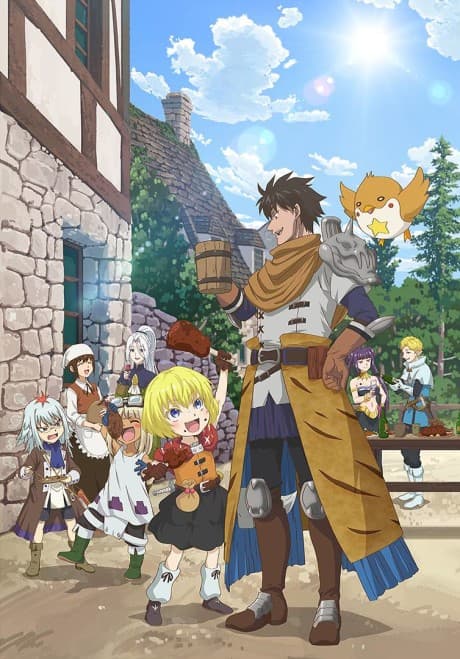
Hajime Shinonome represents one of fantasy's most enduring tropes: the battle-hardened warrior who has earned his peaceful retirement. Having survived a childhood in the slums through sheer determination, he now enjoys what the synopsis describes as a "peaceful and carefree life" in Komai Village. On paper, this setup contains fascinating potential—what does strength look like when it's no longer needed for survival? How does someone who defined themselves through struggle adapt to tranquility? Unfortunately, the show answers these questions with the narrative equivalent of a shrug. Hajime exists primarily as a functional device, a steady presence whose primary purpose is to rescue Lirui and provide her with stability. His traumatic past is mentioned but never explored, his current contentment presented as an endpoint rather than an ongoing psychological state. Lirui suffers similarly—abandoned by her parents and nearly consumed by a slime (the weakest monster in fantasy taxonomy, which feels like an intentional commentary on her perceived helplessness), she exists primarily as a catalyst for Hajime's protective instincts. Their dynamic should be the emotional core of the series, but at three minutes per episode, it never develops beyond the most basic expressions of found family tropes. They're less characters and more character-shaped objects moving through predetermined narrative spaces.
The G-rating paradox: When "all ages" means "no edges"
With its G rating and original source material, An Adventurer's Daily Grind positions itself as family-friendly fantasy, but this designation reveals one of its fundamental contradictions. Truly great all-ages entertainment understands that appealing to everyone doesn't mean sanding down all complexity—Studio Ghibli's films, for instance, tackle profound themes of environmentalism, grief, and transformation while remaining accessible to younger viewers. By contrast, this series seems to interpret "all ages" as "no conflict," presenting a world where even the slime that's partially eating Lirui feels more like a narrative inconvenience than an actual threat. The result is a fantasy setting devoid of genuine stakes, where danger exists only to be immediately neutralized by Hajime's competence. This creates a peculiar tonal dissonance: the show wants us to believe Hajime's past was brutal enough to shape his entire identity, yet presents his present as so conflict-free that it borders on anesthetic. It's the fantasy equivalent of a security blanket—soft, comforting, and utterly lacking in texture or tension. In an industry where even children's programming increasingly recognizes that young audiences can handle complexity, this approach feels curiously dated, like a relic from an era when "family-friendly" was synonymous with "emotionally sanitized."
Studio HORNETS and the economics of micro-content
The production background of An Adventurer's Daily Grind reveals much about its limitations. Studio HORNETS isn't exactly a household name in anime circles, and the show's technical aspects reflect what appears to be an extremely modest budget. Animation is functional at best, with limited movement and backgrounds that feel more like placeholders than actual locations. Yet to dismiss the series purely on production values would miss the larger point: this is anime designed for the streaming era's content churn, where quantity often trumps quality and the goal is less to create art than to fill catalog space. The three-minute runtime isn't an artistic choice so much as an economic one—it allows for rapid production and easy consumption, perfect for viewers scrolling through Crunchyroll between more substantial shows. In this context, the series' low MAL score and minimal engagement (1,228 members, zero favorites) become less a judgment of quality than a reflection of its fundamental nature: this is background noise, something to have on while doing other things rather than something to actively engage with. It represents a troubling trend in which anime becomes less about storytelling and more about content generation, where the metric of success shifts from artistic achievement to algorithmic compatibility.
The "fans also liked" section as cultural ghost town
Perhaps the most telling piece of data about An Adventurer's Daily Grind isn't its score or episode count, but its "fans also liked" section on MyAnimeList, which lists two other series with exactly one vote each: ?/Sankaku no Rhythm/Trump no Arasoi and Nice to See You. This isn't just statistical noise—it's a portrait of cultural obscurity so complete that it becomes almost poetic. These aren't shows that inspired passionate followings or heated debates; they're digital ghosts, barely registering even within the niche communities that typically sustain low-profile anime. This context transforms An Adventurer's Daily Grind from merely a bad show into something more interesting: a case study in what happens when a creative work fails to connect with anyone, when it exists in that peculiar liminal space between creation and cultural relevance. The series joins a long tradition of forgotten media, but with a twist—in the age of streaming and infinite choice, obscurity has become its own kind of aesthetic, a quality that defines as much as it diminishes.
The bottom line: Comfort food without nourishment
Final Score: 3/10 – For completionists and cultural archaeologists only.
An Adventurer's Daily Grind at Age 29 isn't so much bad as it is negligible—a show that occupies space without ever justifying its existence. Its three-minute episodes feel less like narratives and more like narrative suggestions, sketches of ideas that never develop into actual stories. Hajime and Lirui remain archetypes in search of depth, their relationship a premise rather than an exploration. The fantasy setting provides backdrop without texture, conflict without consequence. Yet within this emptiness lies a peculiar kind of honesty: this is anime as pure product, content designed to fill a slot in a streaming schedule rather than to communicate anything meaningful. It's the television equivalent of elevator music—pleasant enough in the moment, utterly forgettable once it ends, and ultimately serving a function that has little to do with art. In an industry increasingly dominated by franchise extensions and algorithm-driven production, the series stands as a quiet monument to creative minimalism pushed past its breaking point, a reminder that sometimes, less isn't more—it's just less.