Tune In to the Midnight Heart plays the same old song with slightly better production values
There's a particular kind of anime that feels less like a creative endeavor and more like a factory assembly line product, where the parts are so familiar you could assemble them blindfolded. Tune In to the Midnight Heart is that anime—a perfectly competent, utterly predictable romantic comedy that feels like it was generated by an algorithm trained on every high school harem show from the last two decades. The premise promises mystery and emotional resonance: a boy searching for the mysterious radio host who comforted him during lonely nights, only to discover his quest leads him to a broadcasting club with four distinct girls, each with their own vocal aspirations. But what could have been a meditation on connection, voice, and memory instead becomes a checklist of genre tropes executed with just enough polish to avoid being actively bad, but not enough originality to be memorable.
Director Masayuki Takahashi (whose previous work includes similarly competent but unremarkable productions) and writer Yukie Sugawara have crafted something that feels like comfort food for those who've already consumed dozens of similar meals. The show airs on the Ka-Anival!! block, a programming slot known for its youth-oriented content, and Midnight Heart fits perfectly into that mold—inoffensive, mildly entertaining, and designed to be consumed without demanding much from its audience. With a MAL score hovering around 7.23 and a relatively modest following of just over 50,000 members, the series exists in that middle ground of anime: not terrible enough to be infamous, not brilliant enough to be essential, just... there.
The Harem Formula: When Four Girls Are Better Than One (For Marketing Purposes)
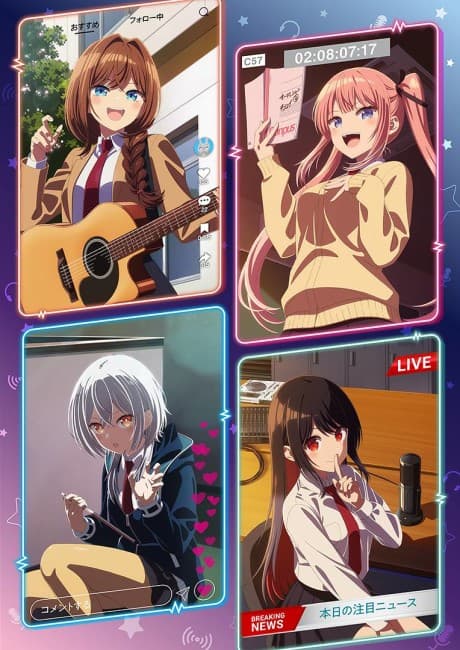
Let's be honest about what Tune In to the Midnight Heart really is: a harem anime dressed up with a radio gimmick. The four girls of the broadcasting club—Nene Himekawa, Rikka Inohana, Iko Kirino, and Shinobu Uzuki—aren't characters so much as they are archetypes with voice boxes. Himekawa is the earnest leader type, Inohana the shy one with hidden talents, Kirino the energetic comic relief, and Uzuki the cool, mysterious beauty. They each have exactly one personality trait related to their vocal aspirations, which the show dutifully explores in episodic fashion while protagonist Arisu Yamabuki stands awkwardly in the middle, trying to figure out which one might be the mysterious Apollo.
What's fascinating about this setup isn't the execution (which is rote), but the cultural context it exists within. The harem genre has been a shounen staple for decades, from Tenchi Muyo! to Love Hina to the more recent Quintessential Quintuplets (which MAL users correctly identified as a similar show). Midnight Heart doesn't reinvent the wheel; it just gives it a fresh coat of paint. The radio angle provides a thin veneer of uniqueness, but ultimately serves as little more than a MacGuffin to keep Arisu interacting with the girls. There's something almost nostalgic about watching a show play these tropes so straight in 2024—like finding a VHS tape of a 2005 anime you'd completely forgotten about.
The Sound of Silence: When Production Values Can't Save a Generic Script
Where Midnight Heart actually shows some genuine craft is in its audio production, which is ironic given that sound should be central to a show about voices. Sound director Yuuichi Morita (whose credits include more ambitious projects) brings a level of polish to the audio that the writing doesn't deserve. The radio segments have a warm, intimate quality, and the voice actresses (particularly for the main quartet) deliver performances that occasionally hint at depths the script never explores. The opening theme, "Tsuki ni Mukatte Ute" by virtual YouTuber Suisei Hoshimachi, is actually a standout—a catchy, emotionally resonant track that suggests a better, more ambitious show than the one we're watching.
Visually, directors of photography Akio Hayashi and Souta Hiroshima deliver workmanlike but uninspired compositions. The character designs are pleasant but generic, the school and clubroom settings could be from any of a hundred other anime, and the animation only really comes alive during the rare moments when characters are performing. There's a telling moment in episode four when Rikka Inohana finally overcomes her shyness to deliver a broadcast—the camera work becomes more dynamic, the lighting more dramatic, and for just a minute, the show feels like it might actually be about something. Then we're back to Arisu blushing because three girls accidentally touched his hand at the same time.
The Ghost in the Machine: What Happened to the Mystery?
The most frustrating aspect of Tune In to the Midnight Heart is how it squanders its most promising element. The central mystery—who is Apollo, and why did she disappear—should be the engine driving the entire narrative. Instead, it becomes background noise, occasionally referenced but rarely explored with any real urgency. Arisu's search feels less like an emotional quest and more like a plot device to keep him hanging around the broadcasting club. The show seems afraid to commit to its own premise, perhaps worried that genuine mystery would interfere with the harem comedy formula.
Compare this to shows that actually explore similar themes effectively. Welcome to the NHK used its protagonist's isolation and media consumption as a springboard for genuine psychological exploration. Even within the romance genre, Toradora! managed to balance comedy with real emotional stakes. Midnight Heart wants to have it both ways: the emotional weight of a mystery drama and the lighthearted fun of a harem comedy, without committing fully to either. The result is a show that feels tonally confused, never quite sure what it wants to be when it grows up.
The Demographic Dilemma: Shounen in a Post-Shounen World
Tune In to the Midnight Heart is unapologetically shounen, aimed at teenage boys who want to imagine themselves as Arisu—surrounded by attractive girls who find him interesting for reasons that are never entirely clear. But here's the interesting cultural question: in 2024, does this demographic still exist in the same way? The anime landscape has evolved dramatically since the heyday of harem comedies, with isekai dominating the shounen space and more sophisticated romance stories finding audiences across demographics. Shows like Kaguya-sama: Love Is War have raised the bar for romantic comedies, blending genuine wit with emotional depth.
Midnight Heart feels like a throwback, not just in its tropes but in its entire approach to storytelling. It assumes an audience that's satisfied with familiar patterns rather than hungry for innovation. The MAL data supports this—with only 264 favorites out of 52,739 members, the show has failed to inspire passionate fandom. It's the kind of series people watch because it's there, not because they're particularly invested. In an era where anime fandom has become more critical and discerning, a show this generic struggles to make a case for its own existence beyond filling a timeslot.
The Bottom Line: Perfectly Adequate Background Noise
Here's the thing about Tune In to the Midnight Heart: it's not bad. The production is competent, the voice acting is solid, and there are moments—usually involving the actual broadcasting segments—that show genuine charm. If you're looking for something to watch while doing homework or scrolling through your phone, it'll do the job. But in a medium as rich and varied as anime, "not bad" feels like damning with faint praise.
The show's fundamental problem is that it lacks ambition. It wants to be pleasant rather than challenging, familiar rather than innovative, safe rather than risky. In doing so, it becomes the audio equivalent of elevator music—technically proficient but emotionally inert. The mystery of Apollo becomes less about the character and more about why anyone involved thought this premise deserved such generic treatment.
Final Score: 6/10 – The anime equivalent of a microwave dinner: it'll fill you up, but you won't remember it tomorrow. For those craving romantic comedies with actual personality, you're better off revisiting classics or seeking out more innovative recent offerings. Tune In to the Midnight Heart plays all the right notes, but forgets to put any heart into the performance.