TRIGUN STARGAZE weaponizes nostalgia to confront the impossible burden of forgiveness
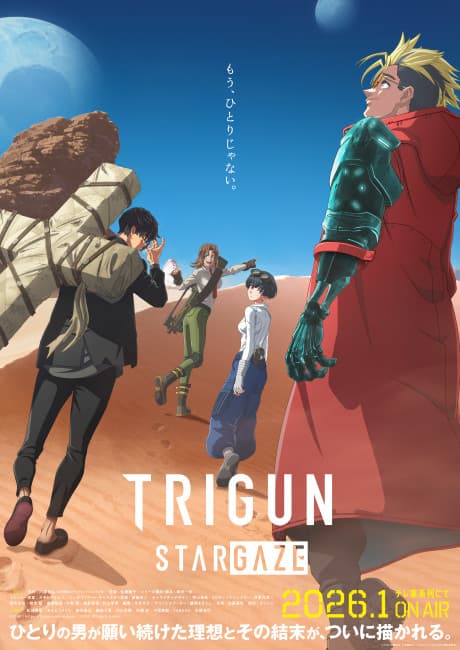
There's a particular kind of exhaustion that settles into Vash the Stampede's shoulders in TRIGUN STARGAZE that feels more earned than any animation studio could possibly render. Two and a half years after the Lost JuLai tragedy—a cataclysm that literally reshaped the planet—the legendary Humanoid Typhoon has shed his iconic red coat for the drab anonymity of 'Eriks,' hiding in a backwater town like a ghost haunting his own legend. This isn't the manic, donut-obsessed goofball of the 1998 series, nor even the traumatized but determined survivor of TRIGUN STAMPEDE. This is a man who has tried to outrun the physics of his own morality, only to discover that in the economy of violence, debts compound with interest. Director Masako Satou and writer Kazuyuki Fudeyasu aren't just continuing a story here; they're conducting an autopsy on the very concept of pacifism in a universe that treats kindness as a structural weakness. In an era where anime protagonists increasingly solve problems with bigger explosions and cooler power-ups, TRIGUN STARGAZE asks the most radical question of all: What happens when the man who refuses to kill is responsible for more death than any tyrant?
The weight of a name: When a legend becomes a liability
Vash's decision to rename himself 'Eriks' is more than a witness protection program maneuver—it's a metaphysical divorce from his own identity. The name 'Vash the Stampede' carries the gravitational pull of myth, attracting bounty hunters, desperate civilians, and the ghosts of JuLai with equal force. By shedding it, he attempts the impossible: to stop being a symbol and become merely a man. Yet the show immediately undercuts this fantasy. When young Jessica arrives with an SOS from the third colony ship, she's not seeking Eriks the handyman; she's seeking the legend, the only force capable of intervening in a conflict that predates human settlement on this desert planet. Satou's direction emphasizes this tension through quiet, lingering shots of Vash's hands—tools that have built shelters and planted gardens, but which the audience knows can level cities. The genius of TRIGUN STARGAZE lies in how it makes us feel the physical burden of that contradiction. Every plant robbery (those mysterious energy sources that keep this dying world alive) that Meryl and Milly investigate, every whisper of Millions Knives's resurgent organization, is a reminder that Vash's retirement is a luxury this broken world cannot afford. His pacifism, once portrayed as a noble ideal, now reads like a form of negligence.
Journalism as trauma response: Meryl Stryfe and the impossibility of objective truth
If Vash represents failed idealism, Meryl Stryfe embodies the journalistic impulse to make sense of the rubble. Promoted to senior reporter at Bernardelli News, she's no longer the wide-eyed insurance agent chasing a story; she's a professional documenting a planet's nervous breakdown. Her dynamic with new sidekick Milly Thompson (who boasts a surprising 457 favorites on MAL, suggesting audiences have immediately connected with her grounded optimism) creates a fascinating generational contrast. Meryl carries the weight of what she witnessed at JuLai—the literal earth-shattering consequences of the Vash/Knives conflict—while Milly represents the next wave, trying to report on a crisis whose origins feel like ancient history. Their investigation into the plant robberies becomes a metaphor for the show's central concern: How do you cover a present that's being actively sabotaged by the past? When they encounter Wolfwood—the priest with a past as bloody as his crucifix is large—the reunion isn't celebratory. It's the collision of three people who survived an apocalypse and are now trying to file the paperwork. In an era of 'fake news' and narrative warfare, TRIGUN STARGAZE presents journalism not as a quest for scoops, but as a form of collective therapy, an attempt to stitch together a coherent story from fragments of catastrophe.
The colonial ghost in the machine: When salvation arrives as another form of violence
Just as the pieces begin to reassemble—Vash emerging from hiding, Meryl closing in on the truth, Knives's machinations thickening the plot—the series delivers its masterstroke: a message from deep space. 'We are a fleet of colony ships from Earth... Those who wish may accompany us to a new frontier.' The entire planet rejoices at this deus ex machina, this literal escape hatch from their dying world. It's a narrative twist that recalls the best of classic sci-fi, from Battlestar Galactica's search for Earth to the generation ship dilemmas of The Expanse. But TRIGUN STARGAZE immediately subverts this hope. The arrival of potential salvation coincides perfectly with the return of the 'one-winged angel'—presumably Knives or his forces—to 'wreak havoc and despair.' This isn't coincidence; it's causation. The promise of a new beginning activates the trauma of the old one. The colonial ships represent the original sin of this universe: humanity's flight from a ruined Earth to colonize a new world, a process that created the Plants, birthed Vash and Knives, and set in motion all the suffering that followed. Now history offers to repeat itself, and the show asks whether these characters—and by extension, humanity itself—have learned enough to break the cycle. The fleet's arrival isn't rescue; it's a mirror held up to a civilization that has spent generations failing to solve its fundamental problems.
Orange's aesthetic alchemy: How 3D animation learned to carry emotional weight
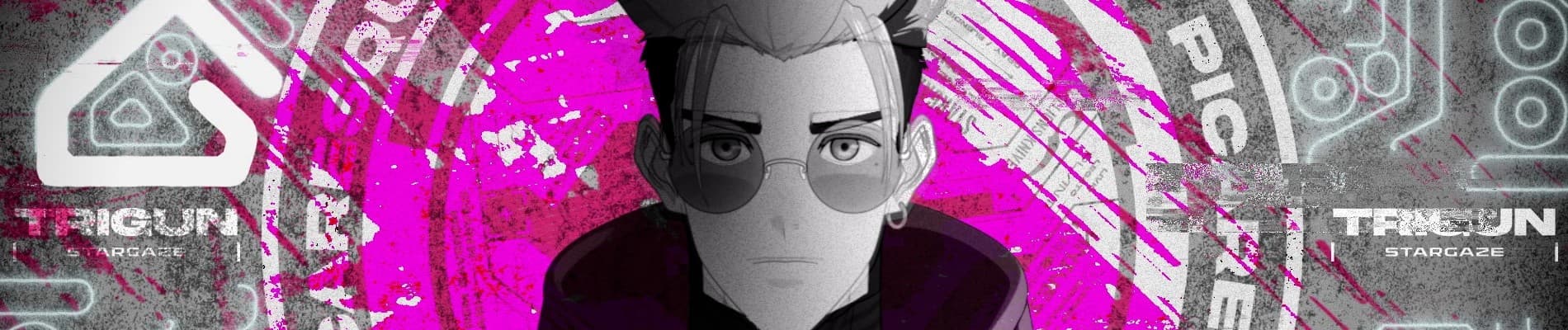
Studio Orange, having already turned heads with TRIGUN STAMPEDE's bold 3D reimagining, continues to refine their alchemical blend of digital precision and tactile soul. The desert landscapes of Gunsmoke feel less like rendered environments and more like geological memories—vast, empty, and scarred by past violence. When the action erupts, Orange's signature fluidity makes every bullet and energy blast feel physically consequential, but it's in the quiet moments that their technique truly shines. The weariness in Vash's eyes, the determined set of Meryl's shoulders as she interviews another traumatized survivor, the way dust motes hang in the air of a forgotten saloon—these details accumulate into a mood that 2D animation often struggles to achieve with such consistency. The opening theme, 'Picaresque Hero' by ano, perfectly captures this tonal complexity with its blend of upbeat rhythm and melancholic undertones, while FOMARE's ending theme 'Stardust' feels like a lullaby for a world that has forgotten how to sleep. In an industry where 3D animation is often relegated to mecha sequences or background crowds, Orange demonstrates that the medium can carry profound emotional weight when placed in the right artistic hands.
The inheritance of violence: Why TRIGUN remains relevant 25 years later
What makes TRIGUN STARGAZE more than just a competent sequel is how it engages with the core philosophical dilemma that has defined the franchise since Yasuhiro Nightow's original manga: the practical impossibility of absolute pacifism in a violent world. Previous iterations presented this as Vash's personal cross to bear, but STARGAZE expands it into a societal diagnosis. The plant robberies aren't random crimes; they're symptoms of a resource-starved civilization reverting to desperate measures. Knives's return isn't just a villain's comeback tour; it's the inevitable resurgence of the belief that some lives are worth more than others, that survival justifies atrocity. When the colonial fleet offers escape, they're essentially proposing to take this unsolved equation to a new planet, guaranteeing future conflict. Against this bleak calculus, Vash's refusal to kill feels increasingly like a beautiful, useless artifact. Yet the show never dismisses his idealism as naive. Instead, through characters like Milly—who approaches every situation with open-hearted courage—and through Meryl's dogged pursuit of truth over easy narratives, STARGAZE suggests that the alternative to Vash's impossible standard isn't pragmatic violence, but collective responsibility. The 'final conclusion for the panicked planet' promised in the synopsis won't come from a final showdown between brothers, but from whether the people of Gunsmoke can build something from the rubble that doesn't require a pacifist messiah to sustain it.
The bottom line
TRIGUN STARGAZE doesn't just continue a story; it deepens a 25-year conversation about violence, forgiveness, and what we owe to those we've failed to protect. With sharp writing from Kazuyuki Fudeyasu that respects the franchise's history while pushing it into new thematic territory, and confident direction from Masako Satou that understands when to dazzle with action and when to sit in uncomfortable silence, this isn't merely a worthy sequel—it's essential viewing for anyone who believes anime can tackle adult questions without losing its soul. The 7.37 MAL score feels provisional, likely reflecting some fans' adjustment to the series' more deliberate, psychologically complex pace compared to its predecessors. But as the pieces continue to fall into place across its 12-episode run, STARGAZE is positioning itself as that rare sequel that doesn't just extend a story, but recontextualizes everything that came before. In the end, Vash the Stampede isn't trying to save the world anymore; he's trying to save the idea that the world is worth saving. And in 2024, that might be the most radical premise in anime.
Final Score: 8.5/10 – A thoughtful, visually stunning evolution of a classic that isn't afraid to let its heroes grow weary.