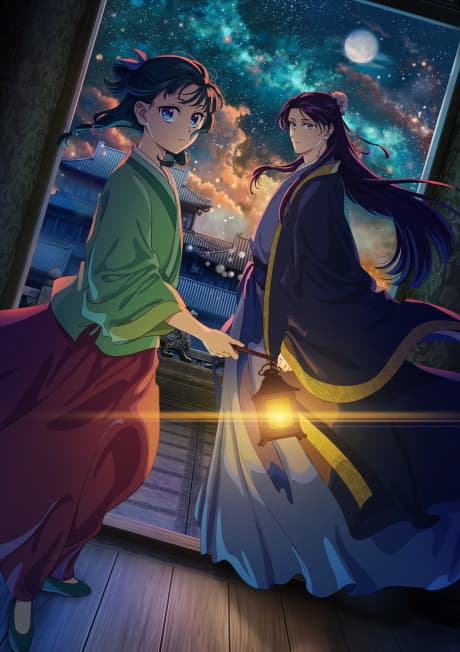
The Apothecary Diaries Season 2 proves that the most dangerous poison in the imperial court is patriarchy itself
There's a moment in The Apothecary Diaries Season 2 where Maomao, our sharp-tongued, poison-savvy protagonist, stares down a merchant caravan's suspicious cargo with the weary resignation of someone who's seen this particular brand of nonsense before. She's not surprised by the intrigue—she's annoyed by it. This subtle shift in emotional register, from the wide-eyed curiosity of Season 1's newcomer to the jaded expertise of Season 2's seasoned investigator, encapsulates what makes this second installment not just a continuation, but an evolution. Under the dual direction of Akinori Fudesaka and Norihiro Naganuma, The Apothecary Diaries transforms from a clever mystery-of-the-week procedural into something far more ambitious: a systemic critique of power structures disguised as historical drama, where the real toxins aren't in the apothecary jars but in the very architecture of the imperial court.
When the mystery becomes the system
Season 1 of The Apothecary Diaries established Maomao as a brilliant outsider solving discrete puzzles—poisoned consorts, mysterious illnesses, palace intrigues that could be neatly wrapped up in 24-minute packages. Season 2, adapting the third and fourth light novel volumes, pulls back the camera to reveal that the individual mysteries were never the point. The real puzzle is the system itself. The arrival of the merchant caravan isn't just another case for Maomao to solve; it's a Trojan horse that exposes how the court's economic dependencies, gender politics, and information control create vulnerabilities that can't be solved with a single antidote. This structural approach to storytelling elevates the series beyond its genre trappings. Where Season 1 felt like a smarter-than-average Gosick (one of the MAL "fans also liked" comparisons), Season 2 operates more like a historical The Wire, where solving one case only reveals deeper, more entrenched problems. The show's 8.91 MAL score and #21 ranking suggest audiences have recognized this sophistication—they're not just watching for the mysteries, but for the systemic critique.
Maomao's quiet revolution: Literacy as liberation
One of Season 2's most quietly radical subplots involves Maomao teaching the consorts' ladies-in-waiting to read. On the surface, it's a charming character moment that showcases her unexpected patience. But dig deeper, and it's a revolutionary act in a setting where knowledge is deliberately restricted to maintain power hierarchies. Director Fudesaka frames these scenes with remarkable subtlety—the camera lingers on the women's hands tracing characters, their expressions shifting from frustration to dawning comprehension. This isn't just education; it's empowerment through literacy, a theme that resonates far beyond the anime's historical Chinese-inspired setting. In a pop culture landscape where female empowerment often manifests as physical combat or political maneuvering (think Chang Ge Xing, another MAL comparison), The Apothecary Diaries suggests something more fundamental: the ability to read and write might be the most subversive skill in an oppressive system. Maomao, with her 22,309 favorites on MAL (dwarfing Jinshi's 2,848), becomes not just a detective but a revolutionary educator, using her medical knowledge as a Trojan horse for something more dangerous: knowledge itself.
Jinshi's diminishing returns and the problem of pretty eunuchs
Let's address the elephant—or rather, the exceptionally handsome eunuch—in the room. Jinshi, the series' male lead, suffers from what might be called "pretty boy syndrome" in Season 2. While his dynamic with Maomao remains the emotional core that drives much of the fan engagement (those 2,848 favorites don't lie), the season's structural shift toward systemic critique leaves him somewhat adrift. His political machinations, which felt central in Season 1, now seem like surface-level maneuvering compared to Maomao's deeper engagement with the court's foundational problems. This isn't necessarily a flaw—in fact, it might be intentional commentary on the limitations of working within the system versus challenging its premises. But it does create an interesting tension: the community voice represented by Excalibur7's 100/100 review celebrates how Season 2 "completes that pack that a series needs to achieve perfection," yet one could argue Jinshi's character development doesn't quite keep pace with the narrative's ambitions. He remains charming, politically savvy, and visually striking, but in a season about digging deeper, he sometimes feels like he's treading water.
The caravan as cultural contamination
The merchant caravan storyline represents Season 2's boldest narrative gamble, and it's where the series' themes crystallize most powerfully. These outsiders bring not just goods but ideas, customs, and potential threats that the insular court can't easily categorize or control. Sound director Shouji Hata deserves particular praise here—the caravan's arrival is accompanied by musical cues that feel distinctly "other," with instrumentation and rhythms that contrast sharply with the established palace soundscape. This isn't just mystery; it's cultural collision. The show smartly avoids easy Orientalism by making the caravan's threat ambiguous—are they malicious infiltrators, or just merchants whose very difference destabilizes the court's carefully maintained equilibrium? In an era where anime often treats foreign cultures as exotic backdrop (or worse, caricature), The Apothecary Diaries uses the caravan to explore genuine questions about isolationism, xenophobia, and the anxiety of cultural exchange. It's heady stuff for a show that could have comfortably rested on its mystery-solving laurels.
Visual storytelling that speaks volumes in silence
TOHO animation STUDIO's work in Season 2 demonstrates how animation can convey meaning beyond dialogue. Episode directors You Akatsuki and Kaho Asai (credited alongside the main directors) craft sequences where the real story happens in the margins—a consort's barely perceptible flinch, the way shadows fall across a corridor to suggest unseen threats, the meticulous detail in apothecary tools that makes Maomao's expertise feel tactile and earned. The 24-minute episode duration, often a constraint for complex storytelling, becomes a strength here through economical visual storytelling. Consider how the show handles Maomao's investigation scenes: instead of lengthy exposition, we get close-ups of her hands testing substances, quick cuts between her observations and her mental deductions, and—most effectively—moments of silence where her thought process becomes almost audible. This visual sophistication helps explain why the series has maintained such high ratings (8.8/10 on the provided score, 8.91 on MAL) across 24 episodes: it trusts its audience to read between the lines, both literally and figuratively.
The music of melancholy and mastery
Lilas Ikuta's opening theme "Hyakka Ryouran" (百花繚乱) and Dai Hirai's ending "Shiawase no Recipe" (幸せのレシピ) deserve analysis beyond their obvious melodic appeal. Ikuta's OP, with its title translating to "Profusion of Flowers," carries ironic weight in a season where beauty often masks danger—the court's floral aesthetics concealing poison both literal and metaphorical. The ED's "Recipe for Happiness" feels similarly layered, suggesting that in this environment, happiness must be carefully constructed, measured, and potentially deceptive. These musical choices reflect Season 2's central tension: the gap between surface appearances and underlying realities. They also connect to the series' broader themes of knowledge and control—just as Maomao understands the precise recipes for both medicine and poison, the characters must navigate recipes for survival, power, and perhaps happiness in a system designed to keep them off-balance.
The bottom line: An essential evolution
The Apothecary Diaries Season 2 achieves what few sequels manage: it deepens rather than merely continues. By shifting from discrete mysteries to systemic critique, from individual poisons to institutional toxicity, it transforms into a richer, more challenging work. The community consensus reflected in its high rankings and reviews like Excalibur7's "one of the greats" assessment isn't just hype—it's recognition of a series that trusts its audience's intelligence. The show's exploration of literacy as liberation, cultural exchange as threat, and knowledge as the ultimate subversive weapon feels remarkably timely despite its historical setting. While Jinshi's character occasionally feels underdeveloped compared to the narrative's ambitions, and the caravan storyline's resolution might leave some wanting more concrete answers, these are minor quibbles in what is otherwise a masterclass in serialized storytelling. Final Score: 9/10—not just a worthy successor, but a series that redefines what historical mystery anime can be.