Tamon's B-Side reveals the empty stage behind idol culture's glittering facade
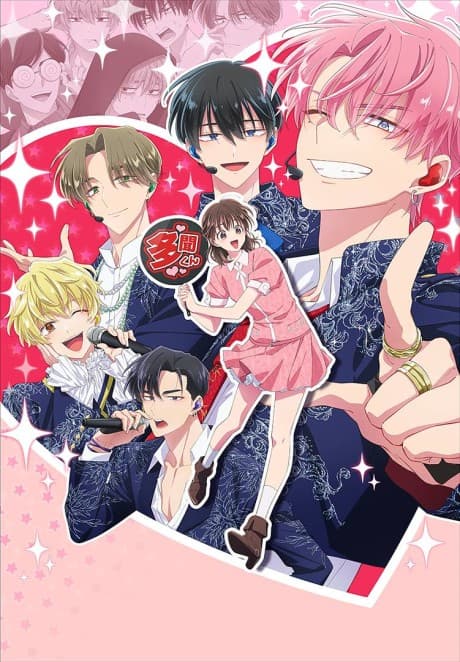
There's a moment in the third episode of Tamon's B-Side that perfectly encapsulates the show's quietly radical premise: Utage Kinoshita, our earnest high-school-housekeeper protagonist, watches her idol Tamon Fukuhara—the charismatic center of boy band F/ACE—struggle to open a jar of pickles in his own kitchen. The camera lingers on his trembling hands, the sweat on his brow, the way his shoulders slump in defeat. This isn't the Tamon who commands stadiums with a wink and a hip thrust; this is a teenage boy who can't handle basic kitchenware. In an anime landscape saturated with idol shows that worship at the altar of manufactured perfection—from the glittering spectacle of Love Live! to the aspirational polish of The Idolm@ster—Tamon's B-Side dares to ask: what happens when the music stops and the makeup comes off? What's left when the persona gets put away with the stage costumes? The answer, as director Nobuaki Nakanishi and his team at J.C.STAFF suggest, is something far more interesting than another round of autotuned triumph: it's the messy, awkward, profoundly human reality that exists in the silence between performances.
The idol industry's dirty little secret: performers are people too
Tamon's B-Side operates on a simple but devastating inversion of the idol genre's usual power dynamics. Where most idol anime position their stars as untouchable deities—objects of worship who exist primarily to be adored—this show immediately demotes Tamon from god to roommate. Utage doesn't meet him backstage at a concert or through some magical fan contest; she's assigned to clean his house through her part-time job. Their relationship begins not with awe but with a mop and bucket. This mundane framing device does more than just set up a meet-cute; it systematically dismantles the idol mythos. We see Tamon's unwashed dishes, his messy bedroom, his inability to function without the protective bubble of his management team. The show's visual language reinforces this demystification: concert scenes are bright, saturated, and dynamically animated, while domestic scenes are rendered in softer palettes with more static compositions that emphasize Tamon's emotional flatness. He's not just playing a character on stage; he's trapped in one, and the show suggests the real tragedy of idol culture isn't the pressure to perform, but the pressure to never stop performing, even when the cameras are off.
Utage Kinoshita: the fan who becomes the witness
What makes this dynamic work isn't just Tamon's vulnerability, but Utage's particular kind of fandom. She's not the screaming fanatic or the obsessive collector that pop culture typically associates with idol worship; she's something more dangerous to the industry's carefully constructed illusions: a quiet observer. Her devotion manifests not in loud declarations but in meticulous attention—she notices the slight tremor in Tamon's voice during interviews, the way his smile doesn't quite reach his eyes in certain photos, the subtle differences between his public and private personas. When she becomes his housekeeper, she doesn't get closer to the idol she worships; she gets further away from him, because the real Tamon bears almost no resemblance to the stage persona. The show's genius lies in making Utage's journey not about achieving some fantasy of proximity to fame, but about navigating the cognitive dissonance of loving someone's art while confronting their profoundly ordinary humanity. Her gradual realization that she's falling for the gloomy, insecure boy behind the glitter—not the perfect idol on stage—becomes a quiet critique of an industry that sells connection while manufacturing distance.
J.C.STAFF's restrained aesthetic: when less animation says more
Given the studio behind Tamon's B-Side—J.C.STAFF, known for everything from the frenetic energy of Food Wars! to the lush romance of Toradora!—the show's visual restraint feels particularly deliberate. Director Nobuaki Nakanishi, working with episode directors including Takafumi Hoshikawa and Yasuo Iwamoto, makes fascinating choices about where to deploy animation resources. Concert sequences burst with life: dynamic camera angles, flowing hair and costume movements, sparkling lighting effects that capture the sensory overload of live performance. But the domestic scenes, which comprise most of the runtime, are notably still. Characters often talk while sitting or standing in place; facial expressions change subtly rather than dramatically; background details remain static. This isn't a budget limitation—it's an aesthetic statement. The stillness forces us to sit with Tamon's discomfort, to notice the way he avoids eye contact, how his shoulders hunch when he's not "on." Sound director Youta Tsuruoka complements this approach with a soundtrack that knows when to disappear entirely, leaving only ambient noise or silence that feels heavier than any musical swell. In a medium that often equates quality with constant motion, Tamon's B-Side understands that sometimes the most powerful statement is what you choose not to animate.
The uncomfortable truth about manufactured intimacy
Where Tamon's B-Side becomes genuinely provocative is in its exploration of the transactional nature of idol-fan relationships. The show constantly juxtaposes two kinds of intimacy: the manufactured kind sold by the idol industry (fan meetings, handshake events, social media interactions) and the authentic, awkward kind that develops between Utage and Tamon in his messy apartment. The former is all surface—scripted conversations, timed interactions, carefully managed appearances. The latter is messy, unscripted, and frequently uncomfortable. When Tamon confesses he doesn't actually like the bright colors he wears on stage, or admits he's terrified of disappointing his fans, he's breaking the fundamental contract of idol culture: the promise that the persona is the person. The show suggests this authenticity, while painful, is ultimately more meaningful than any staged moment of connection. It's a radical idea in a genre built on selling fantasy, and it raises uncomfortable questions about our own consumption of celebrity culture. Are we complicit in demanding performers remain trapped in their personas? Do we prefer the perfect illusion to the flawed reality?
The cultural context: idol anime's existential crisis
Tamon's B-Side arrives at an interesting moment for idol anime, following a decade where the genre dominated charts and conventions. From the global phenomenon of Love Live! to the enduring popularity of The Idolm@ster franchise, the formula seemed unassailable: attractive performers overcome obstacles through friendship and determination, culminating in triumphant performances that validate both their artistry and their personal growth. But recent years have seen more critical examinations of the idol machine—Oshi no Ko's brutal deconstruction of industry exploitation, Zombie Land Saga's meta-commentary on performance as resurrection, even Skip and Loafer's gentle questioning of performative femininity. Tamon's B-Side fits into this emerging subgenre of idol skepticism, but with a crucial difference: where other shows focus on the industry's systemic abuses, this one focuses on the psychological toll of constant performance on the individual. It's less about the machine and more about the person caught in its gears. The show's modest MAL scores (6.6/10, ranked #6864) and low popularity metrics might suggest it's failing to connect, but I'd argue they actually reflect how challenging its central premise is for a genre built on wish fulfillment. This isn't a show that makes you want to be an idol; it's a show that makes you wonder why anyone would choose that life.
The romance that isn't (and why that's the point)
For a show categorized as romance, Tamon's B-Side is remarkably hesitant about actual romance. The relationship between Utage and Tamon develops with glacial slowness, built not on dramatic confessions or fateful encounters, but on accumulated mundane moments: shared meals, quiet conversations, mutual embarrassment. This deliberate pacing serves the show's larger themes about authenticity versus performance. A faster, more conventional romance would undermine the central tension—that Tamon needs to learn how to be a person before he can be a partner. The show suggests his journey toward self-acceptance is more important than any relationship milestone, and that Utage's role isn't to "fix" him but to witness his struggle without judgment. In this sense, the romance genre label feels almost misleading; this is less a love story than a character study about two people learning to see each other—and themselves—clearly. The few moments of traditional romantic tension (a near-confession in episode 8, a protective gesture in episode 10) feel almost like concessions to genre expectations, while the real emotional weight resides in quieter scenes of domestic coexistence.
Final thoughts: the quiet revolution in 24-minute episodes
Tamon's B-Side won't top any popularity charts or inspire viral fan campaigns. Its 13-episode runtime feels both perfect for its intimate scope and frustratingly brief for the character arcs it attempts. The supporting cast—particularly the other members of F/ACE, who remain frustratingly underdeveloped—could use more screen time. The adaptation from game source material occasionally shows in episodic structures that feel more like mission objectives than organic narrative beats. But these flaws feel almost secondary to what the show achieves: a thoughtful, nuanced examination of performance anxiety that extends far beyond the idol industry. In an age where we're all curating personas—on social media, at work, in relationships—Tamon's struggle feels uncomfortably familiar. His "B-Side" isn't just the private self he hides from fans; it's the version of ourselves we're afraid to show anyone. The show's greatest achievement might be suggesting that this hidden self, with all its insecurities and flaws, isn't something to be fixed or hidden, but something to be integrated. In a genre built on selling perfect images, Tamon's B-Side offers something more valuable: permission to be imperfect.
The Bottom Line
Final Score: 7.5/10 – A quietly subversive take on idol culture that values authenticity over spectacle, even if it occasionally struggles to fully develop its supporting cast. Essential viewing for anyone who's ever wondered what happens when the spotlight fades.