My Hero Academia Season 7 trades character for spectacle in its final sprint
There's a moment in the seventh season of My Hero Academia that perfectly encapsulates the show's current predicament. As Star and Stripe—the American hero introduced with all the subtlety of a Marvel crossover event—prepares to sacrifice herself in a battle against All For One, the show pauses for a beat. It's meant to be tragic, this introduction of a compelling new character only to immediately kill her off. But instead of pathos, what we get feels more like narrative whiplash—a symptom of a series that has become so obsessed with its endgame that it's forgotten what made its beginning so special. Directed by Kenji Nagasaki and Naomi Nakayama, this penultimate season represents the franchise at its most technically proficient and thematically hollow, a beautifully animated sprint toward a finish line that feels increasingly predetermined rather than earned.
When world-building becomes world-destroying
My Hero Academia has always been a series about building things up—heroes, relationships, a society worth saving. But Season 7 operates almost exclusively in demolition mode. Following the Paranormal Liberation Front arc's devastating conclusion, Japan's faith in heroes has been shattered, and the show seems determined to break everything else along with it. This isn't inherently bad storytelling; some of the best narratives are about tearing down to rebuild stronger. The problem lies in execution. Where earlier seasons balanced destruction with character moments that gave the destruction meaning, Season 7 often feels like it's checking boxes on a plot spreadsheet. The arrival of Star and Stripe should be a game-changing moment—the internationalization of the conflict, the introduction of new power dynamics—but she's treated more like a narrative device than a character. Her overpowered quirk exists primarily to be stolen, her sacrifice less a tragic loss than a plot necessity. It's world-building at its most utilitarian, expanding the scope while shrinking the emotional stakes.
The spectacle-industrial complex
Let's be clear: Studio BONES still knows how to put on a show. The animation in Season 7's major battles—particularly the Star and Stripe confrontation and the subsequent clashes involving Endeavor, Hawks, and Best Jeanist—is nothing short of spectacular. Masafumi Mima's sound direction elevates every impact, every quirk activation, every desperate shout. But there's a diminishing returns effect at play here. When every battle needs to top the last, when every power needs to be more reality-bending than what came before, you end up with what critic Kaito67 noted in their 70/100 review: "MHA shifts into high gear as we approach the finale." The problem is that high gear becomes the only gear. The quieter moments that once defined the series—Midoriya's nervous muttering, Bakugou's explosive but revealing outbursts, Aizawa's weary professionalism—get crowded out by the need for bigger, louder, more. Even the opening theme, "Ta ga Tame" by TK from Ling tosite sigure, feels appropriately epic but emotionally distant, a far cry from the anthemic hope of earlier seasons' openings.
Character development as casualty
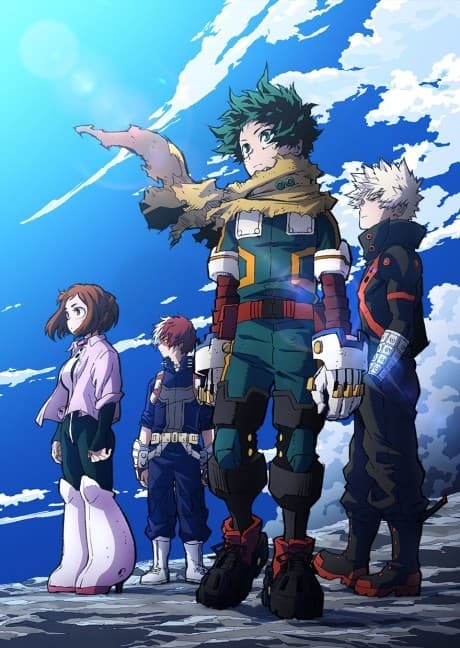
Consider the curious case of Katsuki Bakugou, who remains one of the series' most popular characters (23,982 favorites on MAL) but spends much of this season sidelined or recovering. His journey from bully to hero-in-training has been one of My Hero Academia's most compelling arcs, but here he's often reduced to reaction shots and the occasional explosive intervention. Izuku Midoriya fares slightly better, but even his screen time feels increasingly dictated by plot necessity rather than character growth. The supporting cast—Aizawa, All Might, even the villains—get moments rather than arcs. This isn't to say there aren't powerful character beats; All Might's continued struggle with his powerless state remains poignant, and Aizawa's determination to protect his students even at personal cost still resonates. But these moments feel like islands in a sea of plot progression, reminders of what the show used to prioritize rather than evidence of what it currently values.
The shonen endgame paradox
My Hero Academia finds itself trapped in what I'll call the shonen endgame paradox: the need to escalate stakes to universe-threatening levels while maintaining the personal stakes that made audiences care in the first place. It's a problem that has plagued many long-running battle shonen, from Naruto to Bleach. The community seems divided on how well the series is navigating this challenge. TheAnimeBingeWatcher's 90/100 review praises "some of the most satisfying long-term payoffs in shonen history," while others on forums express frustration with the pacing and character sidelining. Both perspectives have merit. There's undeniable satisfaction in seeing plot threads from seasons ago finally resolved, in watching powers evolve in logical ways. But that satisfaction comes at a cost. The school setting that once defined the series—the classrooms, the training exercises, the mundane moments between crises—has all but disappeared, replaced by a perpetual state of emergency that ironically makes the emergencies feel less urgent.
Cultural context and the superhero saturation point
It's worth considering My Hero Academia Season 7 within the broader context of superhero fatigue. Premiering in a media landscape saturated with Marvel and DC content, the series initially felt refreshing precisely because it approached superheroics through a distinctly Japanese lens—the institutional framework of hero schools, the societal expectations, the emphasis on mentorship. But as the series has progressed, it has increasingly adopted the tropes it once subverted. The global stakes, the universe-threatening villains, the sacrificial plays—these are the building blocks of Western superhero narratives, and their incorporation here sometimes feels less like homage and more like assimilation. Even the introduction of Star and Stripe as an American hero feels like a nod to this cultural crossover, but her characterization leans heavily into stereotypes (the brash, powerful foreigner) rather than offering meaningful commentary on cultural differences in heroism.
The music of melancholy
The season's ending theme, "Tsubomi" by Omoinotake, provides perhaps the most telling contrast to the main action. While the battles rage with increasing intensity, the ED offers a moment of quiet reflection—literally a flower bud (tsubomi) waiting to bloom. It's a beautiful, melancholic piece that feels almost disconnected from the season it accompanies, as if acknowledging that something has been lost in the rush toward conclusion. This musical dichotomy mirrors the season's central tension: between what the show wants to be (a thoughtful exploration of heroism in crisis) and what it feels compelled to be (an action-packed finale setup).
The bottom line
My Hero Academia Season 7 is a technically impressive, narratively efficient piece of television that accomplishes exactly what it sets out to do: move the pieces into position for the final season. With a MAL score of 8.12/10 and ranking #540 in popularity, it clearly satisfies a significant portion of its audience. But for those who fell in love with the series not just for its battles but for its characters, its world-building, its thoughtful exploration of what it means to be a hero, this season can feel like watching a friend become increasingly obsessed with their career at the expense of everything else. The passion is still there, but the personality has been streamlined. As the series approaches its conclusion with the announced Final Season, one hopes it remembers that the most satisfying endings aren't just about defeating the villain—they're about reminding us why we cared about the heroes in the first place.
Final Score: 7.5/10 – A competent but emotionally distant bridge to the finale that prioritizes plot over people.