Journal with Witch quietly dismantles the trauma porn industrial complex
There's a particular kind of quiet that settles over a room when grief has become a permanent resident—not the dramatic, tear-streaked silence of funeral scenes, but the mundane, oppressive quiet of a life that's been fundamentally altered. It's this specific, lived-in silence that Journal with Witch understands with almost unnerving precision, transforming what could have been yet another entry in anime's increasingly crowded 'trauma processing' genre into something far more radical: a story about what happens after the crying stops. In an era where emotional devastation has become a narrative commodity—served up in increasingly elaborate packages of magical girls, isekai tragedies, and apocalyptic backstories—director Miyuki Ooshiro's adaptation of Ikoku Nikki offers the revolutionary proposition that healing might not require spectacle at all. It suggests that the real magic isn't in flashy spells or supernatural interventions, but in the painfully ordinary act of learning how to share space with someone else's pain.
The radical mundanity of Makio Koudai's grief
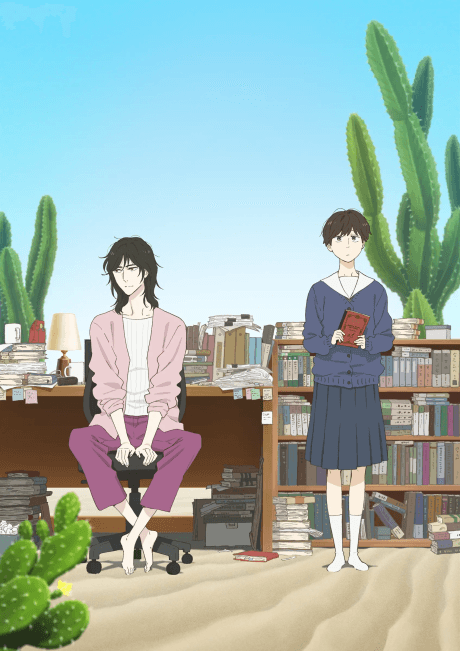
Makio Koudai isn't your typical anime protagonist, and that's precisely what makes her so compelling. As a reclusive novelist who prefers the company of books to people, she represents a character type we've seen before—the socially awkward genius, the emotionally unavailable artist. But Journal with Witch refuses to romanticize her isolation. When Makio becomes the guardian of her 15-year-old niece Asa Takumi following her sister's death, the show doesn't frame this as a heartwarming opportunity for personal growth. Instead, it presents it as what it would actually be: a logistical and emotional nightmare for someone constitutionally unsuited to caregiving. The genius of Makio's characterization lies in how the show uses her profession as a novelist not as a quirky personality trait, but as a genuine psychological framework. Her tendency to observe life rather than participate in it isn't cute—it's a defense mechanism that's served her well until now, and watching it fail spectacularly against the demands of actual human connection provides the series' most quietly devastating moments. When she struggles to cook a simple meal or hesitates before offering a hug, we're not watching a character being 'adorably awkward'—we're witnessing someone whose entire way of being in the world has been rendered inadequate overnight.
Asa Takumi and the unbearable lightness of being fifteen
If Makio represents the paralysis that can follow profound loss, Asa embodies its opposite: the frantic, desperate need to keep moving. At fifteen, she exists in that liminal space between childhood and adulthood where grief manifests not as quiet withdrawal, but as a kind of performative normalcy. The show's josei demographic targeting becomes particularly relevant here—while shonen might have given us a rebellious teen lashing out, and seinen might have offered a brooding, world-weary adolescent, Journal with Witch understands that teenage grief is often expressed through a fierce, almost aggressive commitment to routine. Asa goes to school, does her homework, and tries to maintain the fiction that her world hasn't been shattered because, at fifteen, the alternative—acknowledging the enormity of what's happened—feels like it might actually destroy her. What makes her dynamic with Makio so fascinating is how their coping mechanisms, while opposite in expression, share the same root: a terror of what might happen if they actually stop to feel what they've lost. Their early interactions aren't heartwarming moments of connection, but careful negotiations around emotional landmines—two people trying to share a house without accidentally reminding each other why they're there in the first place.
Shuka Studio's visual language of emotional claustrophobia
For a studio best known for the flamboyant supernaturalism of Durarara!! and Baccano!, Shuka's work on Journal with Witch represents a remarkable exercise in restraint. The visual storytelling here operates on a completely different wavelength than most anime—where other shows might use dramatic camera angles or symbolic imagery to telegraph emotion, Journal with Witch finds its power in what it withholds. Director Ooshiro and her team of episode directors (including Kotomi Deai, Tomomi Kawatsuma, and Mitsuki Kitamura) understand that grief isn't always photogenic. They frame Makio and Asa's apartment not as a cozy home, but as a series of spaces that feel simultaneously too large and too small—rooms that echo with absence during the day but feel suffocatingly intimate at night. The color palette leans heavily into muted earth tones and cool blues, creating a world that feels perpetually on the verge of twilight. Even the character designs reject anime's usual tendency toward exaggerated expressiveness—Makio's face often remains carefully neutral, her emotions conveyed through subtle shifts in posture or the way she holds a book rather than through dramatic close-ups. This visual restraint creates a fascinating tension with the show's title—the 'witch' here isn't a literal magical being, but rather the alchemical transformation that occurs when two people slowly, painfully learn to turn shared grief into something resembling family.
The sound of silence: Takahiro Oomori's auditory landscape
Sound director Takahiro Oomori's work on Journal with Witch deserves particular attention for how it subverts anime's usual auditory conventions. Where most shows use sound to emphasize action or emotion, Oomori uses it to emphasize absence. The soundtrack is notable for what isn't there—long stretches of dialogue-free scenes where the only sounds are the mundane noises of daily life: water boiling, pages turning, the distant hum of city traffic. This isn't the dramatic silence of a horror movie, but the ordinary, sometimes uncomfortable quiet of people who don't yet know how to talk to each other. When music does appear, it's deployed with surgical precision. TOMOO's opening theme "Sonare" feels almost jarringly upbeat against the show's subdued tone—a musical representation of the public face we put on private pain. Meanwhile, Bialystocks' ending theme "Kotozute" provides the emotional release the series itself often withholds, its melancholic melody serving as a kind of auditory decompression chamber after episodes spent in carefully maintained emotional containment. Oomori's sound design creates what might be the series' most radical statement: that healing doesn't always need to be scored.
Journal with Witch in conversation with its spiritual predecessors
The MAL data listing Usagi Drop, Look Back, Fune wo Amu, and Ame to Kimi to as 'fans also liked' provides a fascinating roadmap to understanding what Journal with Witch is actually doing. Like Usagi Drop, it explores the complexities of unexpected guardianship, but where that series eventually succumbed to problematic romantic implications, Journal with Witch maintains a clearer, more respectful boundary between Makio and Asa's relationship. Its connection to Tatsuki Fujimoto's Look Back is particularly illuminating—both works understand that creative people often use their art as both a refuge from and a processing tool for trauma, but where Fujimoto's one-shot embraced dramatic, almost operatic tragedy, Journal with Witch finds its power in smaller, more cumulative moments. The comparison to Fune wo Amu (The Great Passage) highlights both shows' appreciation for the quiet dignity of specialized work—in this case, writing—while Ame to Kimi to shares its gentle, almost therapeutic pacing. What sets Journal with Witch apart from these spiritual cousins is its refusal to offer catharsis on a predictable schedule. Healing here isn't a narrative arc with clear milestones, but a messy, non-linear process that looks suspiciously like just getting through the day.
The bottom line: Why this quiet show matters in a loud medium
Journal with Witch arrives at a fascinating moment in anime's evolution. As the medium becomes increasingly global and mainstream, there's been a noticeable trend toward bigger, louder, more immediately accessible stories—shows designed to grab attention in crowded streaming queues. In this context, a series that requires its audience to lean in rather than dazzles them from a distance feels almost radical. Its 8.48 MAL score (ranking it at #170) despite relatively modest popularity (#3342 with 55,226 members) suggests it's finding exactly the audience it needs: viewers willing to engage with its particular wavelength of emotional realism. The show's josei demographic targeting feels significant too—in a medium still dominated by male perspectives, Journal with Witch offers a nuanced exploration of female relationships that refuses to either sentimentalize or sexualize them. Makio and Asa's bond develops not through dramatic declarations or plot-convenient breakthroughs, but through accumulated small moments: a successfully cooked meal, a shared glance during a difficult phone call, the gradual rearrangement of furniture to make space for another person's life. In an industry that often treats emotional depth as something that needs to be announced with musical swells and dramatic close-ups, Journal with Witch trusts its audience to find meaning in the spaces between words. It's a show that understands that sometimes the most powerful magic isn't in changing the world, but in learning how to live in it after it's already broken your heart.
Final Score: 8.3/10 – A masterclass in emotional restraint that proves sometimes the quietest stories speak the loudest.