Fire Force Season 3 Part 2 burns through its apocalyptic premise with spectacular, empty calories
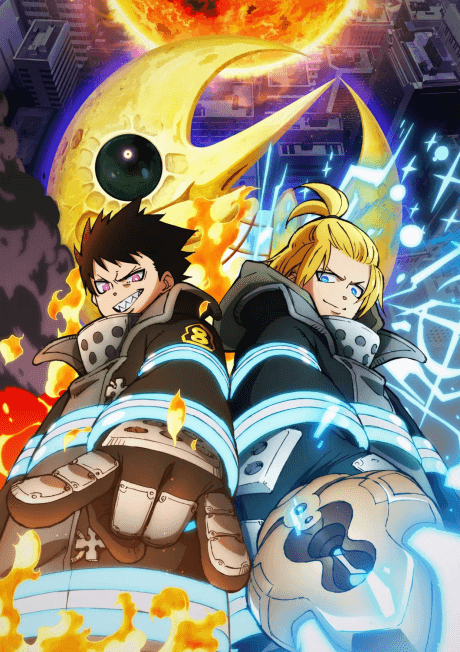
There's a particular kind of anime that feels engineered in a laboratory specifically for the 2 AM Crunchyroll binge—the kind where you can't quite remember individual episodes the next morning, but you know you consumed something with a lot of flashing lights and people yelling about their resolve. Fire Force Season 3 Part 2, the final stretch of Tatsuma Minamikawa's adaptation of Atsushi Ōkubo's manga, is that anime distilled to its purest, most chemically enhanced form. It's the shonen equivalent of eating an entire bag of Flamin' Hot Cheetos: you know there's no nutritional value, your fingers are stained orange, and you feel vaguely ashamed afterward, but damn if you didn't enjoy the immediate sensory overload. As Shinra Kusakabe and Company 8 race to prevent the literal end of the world, the show delivers exactly what it promises—spectacle upon spectacle—while revealing the fundamental emptiness at its core, like a beautifully rendered bonfire that produces no heat.
The apocalypse as a checklist of cool moments
Watching Fire Force's final chapters unfold feels less like following a narrative and more like witnessing a production team methodically checking boxes on a list titled "Things That Look Awesome in Anime." Do we have a character dramatically removing their eyepatch to reveal a glowing, power-sealing eye? Check. Do we have multiple characters achieving new, even more ridiculous power-ups mid-battle while screaming about friendship and duty? Double-check. Does our protagonist, Shinra, get to have a climactic showdown with a god-like being in a dimension made of pure energy? You better believe it. Director Tatsuma Minamikawa and series composer Sei Tsuguta understand their assignment perfectly: deliver maximum spectacle with minimum narrative friction. The problem is that when every moment is engineered to be the coolest thing you've ever seen, nothing actually feels cool anymore. It's the cinematic equivalent of a sugar rush—intense, fleeting, and ultimately unsatisfying. The show treats its apocalyptic stakes with the emotional weight of a video game cutscene you're desperately trying to skip through to get back to gameplay.
Shinra Kusakabe and the curse of the overpowered protagonist
At the heart of Fire Force's narrative limitations sits Shinra Kusakabe, a character whose journey from awkward rookie to literal messiah should feel monumental but instead plays out like watching someone cheat their way through a video game. With 3,113 favorites on MyAnimeList, Shinra clearly has his fans, but his development follows the most predictable shonen trajectory imaginable. He starts with a tragic backstory (check), gains increasingly absurd powers (check), and eventually becomes so powerful that he threatens to unbalance the entire narrative (checkmate). The show tries to give him emotional depth through his relationships with characters like Arthur Boyle (the show's resident himbo knight) and Iris (the pure-hearted nun), but these connections feel perfunctory, existing primarily to give Shinra someone to save or inspire. When compared to more nuanced shonen protagonists like Jujutsu Kaisen's Yuji Itadori (who actually suffers consequences for his power) or even My Hero Academia's Izuku Midoriya (whose growth feels earned through struggle), Shinra's ascent feels unearned and dramatically inert. He's less a character and more a delivery system for increasingly elaborate fire effects.
David Production's technical prowess versus narrative substance
If there's one area where Fire Force Season 3 Part 2 unquestionably delivers, it's in the sheer technical craft on display. David Production, the studio behind the impeccable JoJo's Bizarre Adventure adaptations, brings their A-game to the animation, particularly in the climactic battles. Flames don't just burn in this show—they dance, they explode, they form intricate patterns that would make a pyrotechnics expert weep with joy. Art director Yumi Horikoshi creates a world that's equal parts gorgeous and terrifying, with Tokyo transformed into a hellscape that somehow remains visually compelling episode after episode. Sound director Jin Aketagawa and ADR director Jeremy Inman (handling the English dub) ensure that every explosion has the appropriate earth-shaking bass, every power-up has the right triumphant swell. The opening theme "Ignis" by Takanori Nishikawa and ending "Speak of the Devil" by Survive Said The Prophet perfectly capture the show's tone of desperate, fiery struggle. The tragedy is that all this technical excellence serves a narrative that feels increasingly hollow as it approaches its conclusion. It's like watching a master chef prepare a seven-course meal using only artificial flavors and food coloring—impressive on a technical level, but ultimately unsatisfying to consume.
The supporting cast: wasted potential in a world on fire
Perhaps the most frustrating aspect of Fire Force's final stretch is how it treats its genuinely interesting supporting characters. Takehisa Hinawa, the stoic, tactical genius of Company 8, receives barely any development despite being one of the more compelling adults in the shonen landscape. Akitaru Oubi, the captain whose lack of pyrokinetic abilities makes him an underdog in this superpowered world, gets sidelined in favor of yet another Shinra power-up sequence. Even Tamaki Kotatsu, whose "Lucky Lecher Lure" gimmick was controversial from the start, deserves better than being reduced to occasional fan service in the middle of the apocalypse. These characters have moments where they shine—Hinawa's precise, military-style fire control remains one of the show's visual highlights—but they're ultimately supporting players in Shinra's messiah story. In a better version of this narrative, Company 8 would feel like an actual ensemble, with each member contributing meaningfully to the final battle. Instead, they're largely spectators to Shinra's ascension, which undermines the found-family themes the show occasionally gestures toward.
Urban fantasy without the urban, supernatural without the natural
Fire Force occupies the increasingly crowded space of urban fantasy shonen, but it never quite figures out what to do with its setting. The premise—a world where spontaneous human combustion creates flame-wielding infernals and pyrokinetic firefighters battle them—is genuinely intriguing. Yet as the series progresses, it becomes less about this unique world and more about increasingly abstract cosmic battles. The Tokyo setting, which should feel alive with detail and history, becomes mere backdrop for the next big explosion. Compare this to something like Bleach, which managed to make its version of Tokyo feel like a character in its own right, or Jujutsu Kaisen, which seamlessly blends supernatural elements with real-world locations. Fire Force's world-building feels like set dressing rather than a living, breathing environment. The supernatural elements, meanwhile, become so divorced from any internal logic that they might as well be magic—which wouldn't be a problem if the show didn't keep insisting there are rules to this pyrokinesis system. By the time we reach the god-like beings and reality-bending final battles, any pretense of scientific or systematic explanation has been abandoned in favor of pure spectacle.
The final verdict: a spectacular fire that leaves no warmth
Fire Force Season 3 Part 2 achieves exactly what it sets out to do: deliver thirteen episodes of increasingly spectacular animated destruction as Shinra and Company 8 race to prevent the end of the world. On a purely technical level, it's frequently breathtaking, with David Production demonstrating why they're one of the industry's premier action animation studios. The voice work, both in Japanese and under Jeremy Inman's English direction, sells every moment of desperation and triumph. The music slaps. The flames look incredible. But beneath all that technical polish lies a narrative that's thinner than smoke, characters who never evolve beyond their initial archetypes, and thematic depth that evaporates upon contact. It's the perfect anime for when you want to turn your brain off and watch pretty colors for twenty-four minutes—and there's absolutely nothing wrong with that kind of entertainment. But with its 8.06/10 MyAnimeList score and #634 ranking, it's clear that many viewers wanted something more substantial from this final arc. Fire Force will be remembered not as a classic of the shonen genre, but as a beautifully animated curiosity—a show that burned bright and hot, but left little lasting warmth in its ashes.
Final Score: 6.5/10 – Spectacular to watch, forgettable to remember.